Does Radisson’s "Yes, I Can” Motto Apply To Sustainability? (2025 Report)
When you check into a hotel room, toss your bags onto the bed, and look out the window at a new city, the last thing on your mind is probably the building's carbon footprint. But behind the scenes of the world's major hotel brands, a massive shift is happening. Travelers are no longer just looking for a soft pillow and clean towels; they want to know that their stay isn't destroying the planet or exploiting local communities.
The Radisson Hotel Group (RHG) recently released its Responsible Business Report 2025, giving us an open, data-heavy look into how one of the world's fastest-growing hospitality networks is handling the massive challenges of climate change, worker rights, and community support.
This is important because people are taking notice and to be competitive, hotels are taking action to become more sustainable. Sustainability now plays a role in how travelers choose where to stay. A Booking.com survey found that 76% of travelers want to stay in sustainable accommodation. Properties with visible eco-certifications and transparent sustainability communication ranked higher in traveller trust and credibility. Transparency in sustainability practices, including certifications and demonstrable actions, emerges as the most significant factor for Gen Z.
The Scale of Radisson’s Operation
Before diving into the green details, it is helpful to understand the sheer size of the operation we are talking about. Radisson isn't just a handful of buildings; it is a global ecosystem.
Global Reach: Radisson operates across the Europe, Middle East, and Africa (EMEA) region as well as the Asia-Pacific (APAC) market.
The Footprint: The group manages more than 1,580 hotels in operation and under development across over 100 countries and territories.
The Room Count: This adds up to roughly 250,000 rooms globally.
The Workforce: More than 75,000 team members work directly at Radisson or within hotels licensed under its systems.
The Financials: The group pulled in €1,416 million in revenue for the reporting year.
Corporate Ownership: Since 2019, Radisson has been part of Jin Jiang International, the second-largest hotel group in the entire world.
Given this scale, any positive change Radisson makes can have a massive ripple effect. Conversely, any failure to act leaves a giant environmental and social stain.
Radisson's 2025 report proves that the group is not entirely engaging in greenwashing. They have put real money, massive training hours, and rigorous engineering into pathfinding projects like their Verified Net Zero hotels. Their ability to reduce emissions intensity while aggressively growing their international portfolio is a legitimate achievement that sets a positive example for other massive global hotel chains.
However, the report also clearly highlights where corporate ambition crashes into operational reality. Radisson cannot truly call itself a sustainable leader until it uses its massive financial leverage to fix its foundational flaws. They must drastically accelerate their transition to renewable energy beyond the current 8% average, force mandatory enforcement of human rights protections across 100% of their high-risk hotels, and break the glass ceiling holding back female operational executives.
Pillar 1: Think Planet
Radisson structures its sustainability efforts around three core pillars: Think Planet, Think People, and Think Community. Let's start with the environmental side, which features some of the report's most exciting headlines and its most glaring red flags.
The Big Wins: Decarbonization and the Net Zero Pioneers
Radisson has committed to an ambitious long-term goal: reaching net-zero greenhouse gas emissions across its entire value chain by 2050. These targets have been officially validated by the Science Based Targets initiative (SBTi). Sustainable construction can reduce a building’s operational costs by up to 20% over its lifetime, while preserving the surrounding environment.
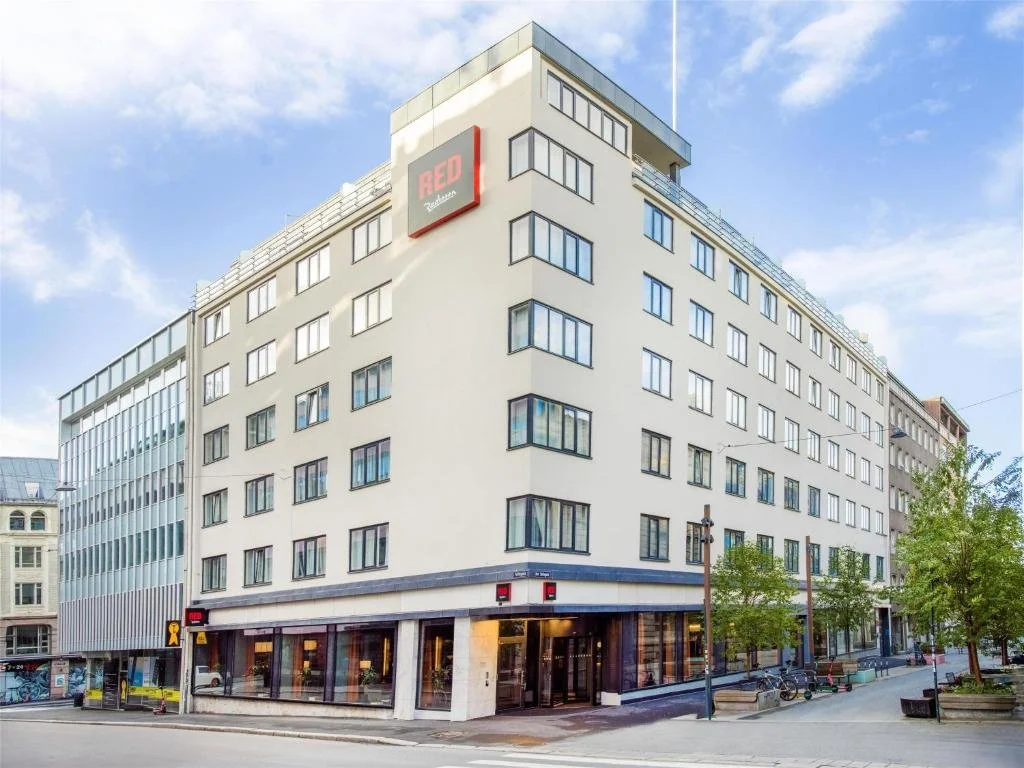
The most impressive milestone of the year was the opening of its first two Verified Net Zero Hotels. Located in Manchester, UK, and Oslo, Norway, these properties serve as a real-world testing ground. They prove that a hotel can achieve net-zero carbon emissions across all three emission scopes using independent third-party verification.
Here is what these pioneer hotels are doing to pull this off:
Full Electrification: The Radisson Hotel Manchester City Centre achieved complete electrification, eliminating all reliance on fossil-fuel heating or cooking systems.
Renewable Energy: The Radisson RED Oslo City Centre transitioned entirely to 100% renewable electricity and heat.
Green Menus: Both hotels completely redesigned their food offerings to prioritize low-carbon, plant-based, and locally sourced dishes, complete with transparent carbon labeling on menus.
Residual Offsetting: Instead of using cheap carbon credits to hide heavy pollution, these hotels eliminate almost all Scope 1 and 2 emissions first. They only use high-quality, regional soil-carbon removal certificates to balance out the tiny, unavoidable residual Scope 3 emissions that remain.
Across the wider portfolio, Radisson has managed to reduce its absolute Scope 1 and 2 emissions by 6% compared to its 2019 baseline. Even better, it improved its emissions intensity per square meter by 23%, proving that the company is successfully decoupling its business growth from its total pollution output.
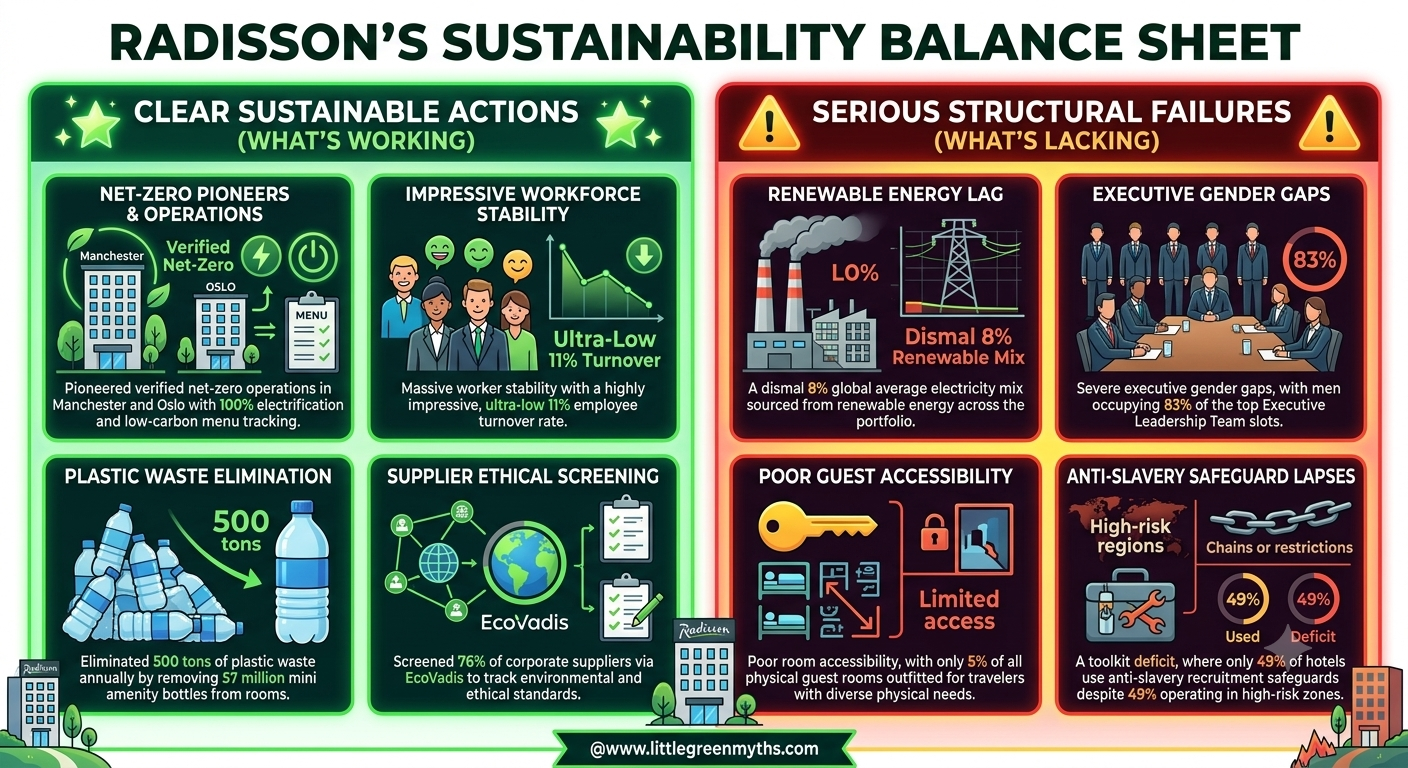
Moving away from those tiny miniature shampoo bottles to bulk amenity dispensers has eliminated 57 million miniature bottles and nearly 500 tons of plastic annually.
The group has deployed 1,699 electric vehicle charging stations across 266 hotels to support low-carbon travel.
Every single corporate meeting held at a Radisson property is carbon-offset by the company at no extra cost to the client, leading to 115,000 tons of CO2e compensated since 2019.
Where Radisson is Failing on the Planet Pillar
While the Net Zero pioneer hotels sound fantastic, they represent a microscopic drop in a massive bucket. At the end of the year, only two hotels out of more than 1,580 were verified net-zero properties. The roadmap aims to scale this to 100 hotels by 2030, but that still leaves well over 90% of the portfolio behind.
The most concerning statistic in the entire environmental section is Radisson's total renewable energy mix. On average, only 8% of the electricity sourced across the global portfolio comes from renewable energy. This means that despite all the talk of green operations, 92% of the electricity keeping the lights on, the air conditioning running, and the kitchens hot is still tied to non-renewable power grids. While 54% of their leased hotel portfolio uses 100% renewable electricity, the vast majority of their managed and franchised properties are lagging heavily.
Furthermore, Radisson admits that while its leased hotels performed strongly, its absolute emissions reductions are being actively sabotaged by increasing emissions in managed hotels across India, the Middle East, and Africa (specifically within Saudi Arabia, Oman, and Eastern Africa). Occupancy patterns and a slow regional transition to cleaner local grids mean that certain geographical sectors are pushing Radisson backward rather than forward.
Pillar 2: Think People
A service-driven company like a hotel group lives or dies by its staff. Under the Think People pillar, Radisson details its workplace conditions, career development pipelines, and its approach to guest safety and human rights.
Big Wins: Education, Engagement, and Fair Wages
In an industry notorious for high staff turnover and intense burnout, Radisson has achieved some remarkably stable labor metrics. On the flip side, hotel staff have a big role in making hotel operations more sustainabile.
Radisson boasts a remarkably low 11% employee turnover rate. In the global hospitality sector, where workers routinely bounce from company to company, keeping 89% of their staff stable is a massive operational win.
The company reports that 98% of all team members are paid at or above the mandatory minimum wage dictated by national legislation or collective bargaining agreements.
Radisson’s annual global employee survey, Radisson Listens, achieved a massive 95% participation rate and returned a global engagement score of 84%. This sits 8 percentage points higher than the average benchmark for the global leisure and hospitality industry.
Radisson invests heavily in corporate learning. During the reporting period, employees completed more than 1 million training courses, translating to an incredible 8.5 million total hours of training. This training includes everything from hospitality basics to dedicated modules on human rights and anti-sex-trafficking awareness.
Radisson is also making progress on building an inclusive workplace. The workforce represents 146 different nationalities, ethnicities, and races. Additionally, women now occupy 31.2% of total leadership positions across the company, representing a steady upward step toward their ultimate goal of hitting a 50/50 gender balance by 2030.
Where Radisson is Failing on the People Pillar
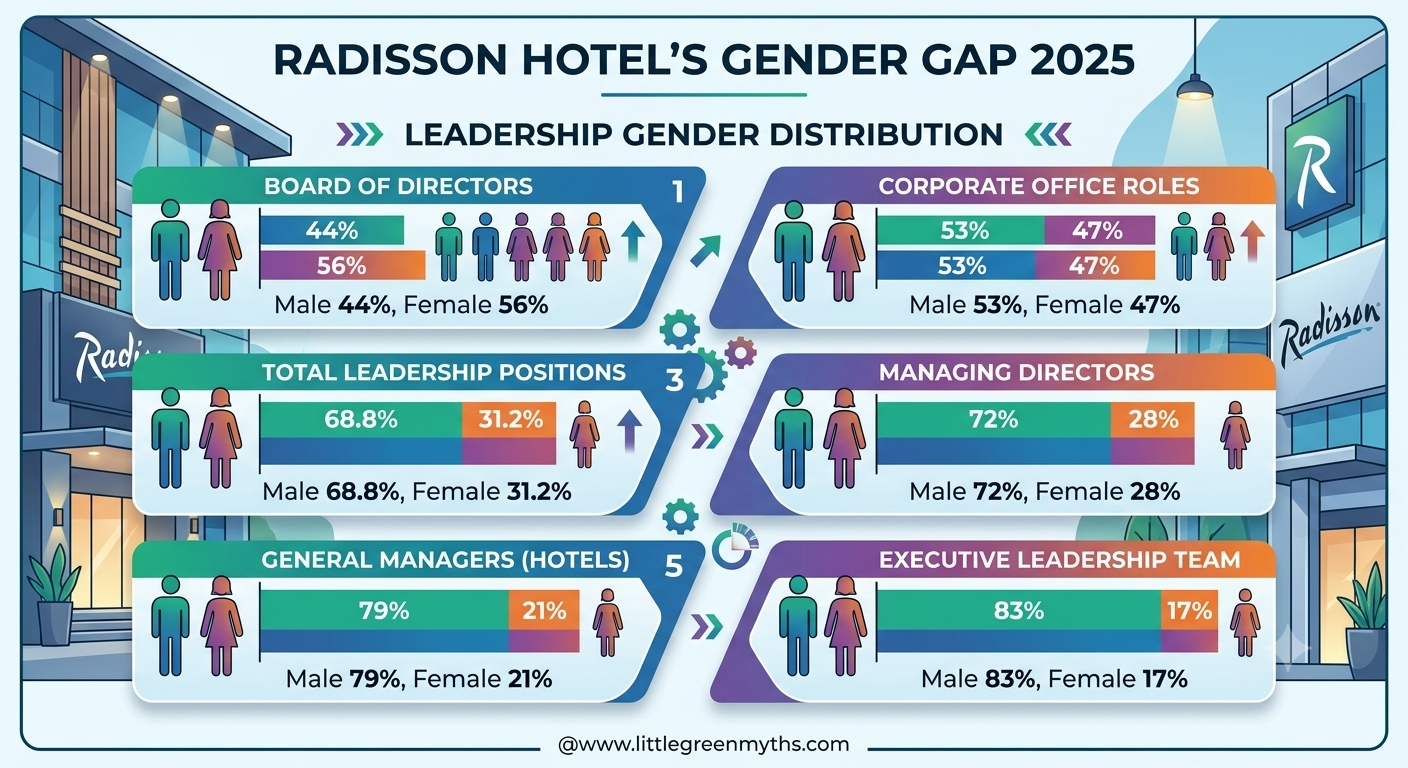
Despite progress toward gender balance in mid-level leadership, the highest echelons of Radisson remain overwhelmingly male-dominated. While the Board of Directors shows an excellent balance (56% female, 44% male), the Executive Leadership Team is a staggering 83% male and only 17% female. Furthermore, the visible face of leadership at the hotel level—the General Managers who run day-to-day operations—is 79% male. There is a clear block preventing female talent from moving out of corporate office settings and mid-level roles into top-tier operational executive positions.
This is a problem. Research shows that simply having one woman on a board isn't enough to change the culture—a phenomenon sometimes called "tokenism." However, they discovered a "Critical Mass" threshold. Once a board has at least two female directors, greenwashing significantly decrease.
Another major area of weakness falls under guest inclusivity and physical accessibility. Across Radisson's entire global portfolio of 250,000 rooms, only 5% of all rooms are fully physically accessible for guests with diverse physical abilities. In a world where accessible travel is a human right, having 95% of your inventory closed off to travelers who require accessible facilities is a massive failure. While they are doing better digitally (hitting 86% compliance with Web Content Accessibility Guidelines for their website), the physical world is severely lagging.
Finally, safety data collection remains incomplete. Radisson utilizes an internal security platform called the Always Care Tool (ACT) to track safety practices and accident prevention data. However, only 60% of hotels actually submitted their quarterly safety data through ACT. While the properties that did submit achieved a 95% compliance score, the fact remains that 40% of Radisson's hotels failed to report their safety data centrally, leaving a massive blind spot in global risk tracking.
Pillar 3: Think Community (Social Impact & Supply Chain Risks)
The final pillar, Think Community, looks outward at how Radisson's operations alter the local economies and human environments surrounding their hotels. This pillar highlights a massive amount of philanthropic effort alongside some deeply concerning numbers regarding human rights risk exposure.
The Big Wins: Rapid Aid, Water Sourcing, and Supplier Screenings
On the charitable side, Radisson does substantial heavy lifting. The company donated over €890,000 in cash and in-kind donations during the year. Employees contributed more than 79,000 volunteer hours to local environmental cleanups, food shelters, and humanitarian causes.
Launched recently, The Radisson People Foundation acts as an emergency safety net for employees facing disaster. In the past year, it mobilized rapid financial assistance to support team members and families devastated by severe typhoons and flooding across Vietnam, the Philippines, Sri Lanka, and Indonesia, helping over 250 people globally.
Through a partnership with the international charity Just a Drop, Radisson uses guest towel reuse and light housekeeping programs to fund clean water infrastructure. To date, they have funded 21 sustainable water, sanitation, and hygiene projects, bringing safe drinking water to more than 34,000 people in water-stressed local communities.
Radisson also deserves credit for screening its suppliers. It has partnered with EcoVadis to track the environmental and ethical behavior of its corporate vendors. Currently, 76% of its global corporate suppliers have been assessed by EcoVadis, giving Radisson major visibility into whether the companies they buy from are using child labor, destroying forests, or engaging in corruption.
Where Radisson is Failing on the Community & Supply Chain Pillar
Despite these philanthropic wins, the report pulls back the curtain on a terrifying reality regarding Radisson's global supply chain and operational geography.
First, Radisson admits that an internal assessment found that 76% of its total contracted procurement spend falls within high- and medium-risk product and service categories from a social and environmental perspective. This means that more than three-quarters of the billions of euros Radisson spends on food, linens, cleaning chemicals, and building supplies goes toward industries that are highly prone to labor exploitation, heavy pollution, or unethical behavior.
Even more alarming is the company's geographical exposure to human rights abuses. Using the independent Human Rights Measurement Initiative risk index, Radisson mapped out its entire global hotel portfolio. The results are stark: 36% of its hotels are located in "High" risk countries, and another 13% are located in "Very High" risk countries. Together, this means nearly half (49%) of Radisson's entire global portfolio operates in territories with an elevated risk of severe human rights violations, modern slavery, labor exploitation, and restricted civil liberties.
Faced with this massive human rights threat, Radisson developed a dedicated Responsible Recruitment and Employment Toolkit to help local hotels spot modern slavery, audit third-party staffing agencies, protect vulnerable migrant workers, and avoid forced labor. But here is the massive failure: only 49% of Radisson hotels actually utilized the toolkit. Despite operating a business where half of their properties sit inside dangerous human rights environments, less than half of their hotels are actively using the exact safety toolkit designed to protect workers from exploitation.
Leaving the implementation of anti-slavery tools as an optional, decentralized choice for hotel managers is an enormous corporate governance failure. It creates a massive loophole where third-party labor suppliers (like outsourced housekeeping, security, and gardening crews, which make up 18% of Radisson's entire labor force) can be exploited without central corporate oversight.
Understanding "Double Materiality"
Throughout the report, Radisson references a process called a Double Materiality Assessment. While that sounds like incredibly dry corporate jargon, it is actually a vital concept for anyone wanting to understand greenwashing versus real corporate honesty.
In the old days of business, companies only looked at sustainability through a single lens: "How will climate change hurt our profits?" (e.g., Will a flood destroy our hotel beach resort?). Double materiality forces companies to look at both directions:
Financial Materiality: How external environmental and social factors impact the company's financial health.
Impact Materiality: How the company’s day-to-day operations impact the outside world.
Radisson mapped out 22 core material topics—ranging from biodiversity loss and water scarcity to corruption and guest safety. The report was assembled using VSME guidelines (Voluntary Sustainability Reporting Standards for Small and Medium Enterprises), with plans to fully transition to mandatory, legally binding ESRS (European Sustainability Reporting Standards) requirements by the 2027 reporting year. This structural approach is a major step toward transparency, as it prevents executives from hiding their negative real-world impacts behind standard, flowery corporate language.