In Whirlpool Just Spinning Their Sustainability Goals? (2025 Report)
Think about the appliances in your home. The refrigerator keeping your milk cold, the stove cooking your dinner, and the washing machine cleaning your favorite jeans after a long week. We rarely think about them until they stop working, but these machines are running quietly in the background of our lives every single day. Because they are everywhere, the companies that make them have a massive impact on our planet.
Whirlpool Corporation—the famous company behind brands like KitchenAid, Maytag, Amana, JennAir, and InSinkErator—recently released its 2025 Corporate Responsibility Impact Report. This document details how the company is managing its environmental footprint, treating its workforce, and interacting with communities around the world.
Whirlpool's 2025 Corporate Responsibility Impact Report paints a picture of a legacy manufacturing giant in transition. They are successfully modernizing their factories, implementing robust software to track carbon data, and proving that an appliance manufacturer can execute powerful social initiatives.
However, the report also highlights the deep structural challenges facing global consumer electronics companies. Designing highly efficient kitchen and laundry appliances matters very little if more than half of returned inventory cannot be refurbished, or if supply chain partners refuse to match corporate climate ambitions.
1. Whirlpool’s Carbon Footprint
To understand any corporate sustainability report, you first have to understand how companies measure greenhouse gas emissions. Carbon emissions are divided into three categories, known as "Scopes":
Scope 1: Direct emissions from sources the company owns or controls (like burning natural gas to heat a factory).
Scope 2: Indirect emissions from electricity the company buys to run its buildings and assembly lines.
Scope 3: All other indirect emissions that happen across the entire lifecycle of a product, including the raw materials bought from suppliers and—crucially—the electricity you use when you run the appliance at home.
The Big Wins in Operations
Whirlpool has made significant strides in cleaning up its own backyard (Scope 1 and 2). In 2025, the company reduced its Scope 1 and 2 market-based emissions by 6% compared to 2024, marking a 55% total reduction since 2021. Their ultimate target is a 65% reduction by the year 2030, meaning they are currently ahead of schedule for their operational goals.
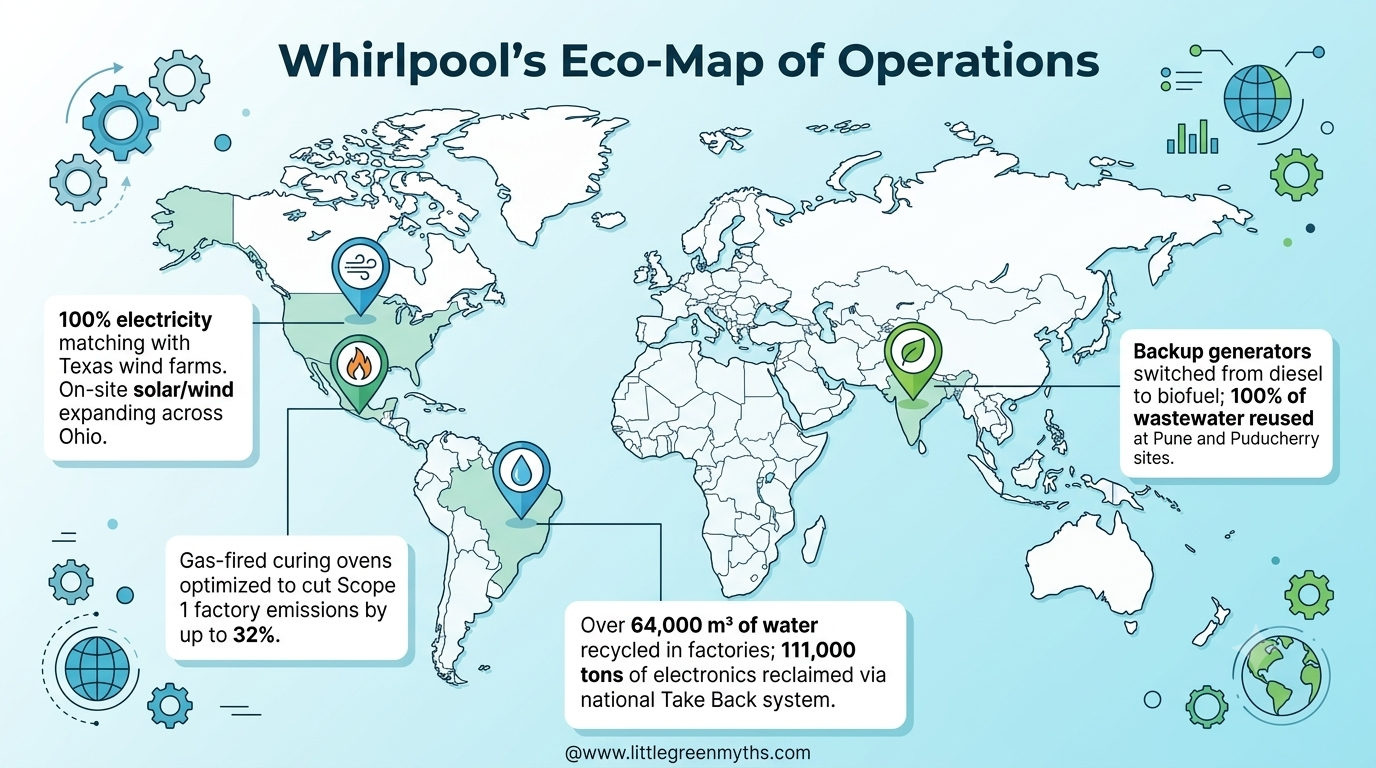
How did they do this? A large part of the answer lies in renewable energy. In 2025, Whirlpool matched more than 80% of its global electricity consumption with renewable energy sources. In the United States, they reached 100% virtual matching for the electricity used in their manufacturing plants and large distribution centers, heavily relying on massive off-site wind projects like the Engie Limestone Wind Farm and Mesquite Sky in Texas.
The Data Upgrade
To keep track of all these massive numbers, Whirlpool upgraded its digital infrastructure by implementing Salesforce Agentforce Net Zero Cloud. In 2025, they successfully integrated all of their Scope 3 calculations into this software. This gives the company a granular, automated look at where carbon is being emitted across its supply chain, making it much harder for emissions data to hide in confusing spreadsheets.
2. Whirlpool and the Circular Economy
An appliance's life shouldn't be a straight line from the factory floor to the landfill. Instead, sustainable companies try to build a circular economy, where products are designed to last, repaired when they break, refurbished for a second life, and responsibly recycled at the very end.
Designing for Sustainability (DfS)
Whirlpool launched over 100 new products globally in 2025. In North America alone, more than 30% of their entire product lineup transitioned to newer, more efficient models. The engineering teams used a framework called Design for Sustainability (DfS), backed by Life Cycle Assessments (LCAs), to select materials that reduce water and carbon footprints without losing performance.
Whirlpool is rapidly expanding induction cooktops across brands like KitchenAid, Maytag, and JennAir. Induction cooking transfers about 85% of heating energy directly to the cookware, compared to a dismal 33% energy transfer rate for traditional gas stoves.
New front-load washing combos in Latin America use Artificial Intelligence (AI) to sense the volume of clothes in the drum. The machine automatically adjusts the water level and cycle duration, saving up to 40% of water and energy per load.
New dishwashers across multiple brands automatically pop their doors open four inches at the end of a wash cycle. This lets water vapor escape naturally, utilizing room ventilation to dry the dishes instead of running energy-hungry internal heating elements.
Giving Appliances a Second Life
What happens when a customer returns an appliance, or it gets minor damage before being sold? Historically, these items were often scrapped. Whirlpool is trying to change this through its Enterprise Circularity program.
In August 2025, Whirlpool launched a Certified-Refurbished Pilot Program in the United States. Operating out of a specialized refurbishment center in Romeoville, Illinois, technicians thoroughly inspect, repair, and test lightly used or returned appliances. If the machine meets like-new performance standards, it receives a certified-refurbished label and is resold at a discount on Maytag.com and Whirlpool.com to consumers in the Chicago area, backed by a one-year warranty.
Globally, across all their refurbishment centers in 2025, Whirlpool handled 765,102 returned products, successfully refurbishing and reselling 369,080 of them. They also donated 6,185 products to philanthropic programs like the Feel Good Fridge initiative, which provides refurbished refrigerators to schools and nonprofits to help fight local food insecurity.
3. Supply Chain and Global Operations
A company is only as green as its supply chain. If a factory claims to be eco-friendly but buys its parts from highly polluting suppliers, the overall system still fails the planet.
Managing the Supplier Network
Whirlpool partnered with EcoVadis, a sustainability rating provider, to audit its global suppliers. In 2025, Whirlpool successfully expanded its data collection to cover roughly 70% of estimated supplier emissions linked to direct production materials.
Furthermore, 69% of the total money Whirlpool spends on components and raw materials now goes to suppliers who have undergone complete sustainability performance assessments—a massive 44% increase compared to 2024. When suppliers score poorly, Whirlpool doesn't immediately cut them off; instead, they launch capability-building initiatives. In 2025, 83% of the suppliers who participated in these improvement programs raised their scores on their next assessment, achieving an average performance jump of 33%.
Localized Sourcing and Regional Water Management
Whirlpool relies on a "produce where you sell" business model. In the United States, 80% of the appliances Whirlpool sells are manufactured inside American factories—which they note is three times higher than the average of their major competitors. Additionally, 96% of the steel used in their U.S. manufacturing is sourced from American producers. This drastically slashes the carbon emissions associated with shipping massive steel coils and heavy appliances across global oceans.
4. Supporting People and Communities
True corporate responsibility isn't just about carbon atoms and water molecules; it is also about human beings. Whirlpool's report highlights several key areas where they are investing in their internal culture and external communities.
Inside the Company
Whirlpool runs a massive global team of 41,000 employees. To check the health of their workplace culture, they distribute regular surveys through an analytical platform called Glint. In September 2025, over 29,000 employees responded, yielding a global employee engagement score of 78. This sits just shy of the global top-quartile benchmark for top-performing international companies.
The report also celebrates milestones within its Employee Resource Groups (ERGs):
Whirlpool Women's Network (WWN): Celebrated its 30th anniversary of continuous advocacy and professional mentorship inside the company.
AVID (Awareness of Visible and Invisible Disabilities): Celebrated its 10th anniversary. Members of AVID actively collaborate with product engineers to design accessible appliances, such as the Whirlpool Spin & Load Dishwasher Rack, proving that inclusive corporate diversity directly impacts product design.
Outside the Company
Whirlpool maintains several long-standing community relationships that use their unique corporate strengths to solve human problems:
Habitat for Humanity: This relationship began in 1999 and has resulted in over $160 million in funding and 260,000 donated appliances. In 2025, CEO Marc Bitzer was elected to Habitat's international board of directors. Whirlpool renewed its BuildBetter with Whirlpool initiative with a $2.5 million grant to construct 50 net-zero-energy-ready homes by the end of 2026, featuring full electrification, solar readiness, and water conservation infrastructure.
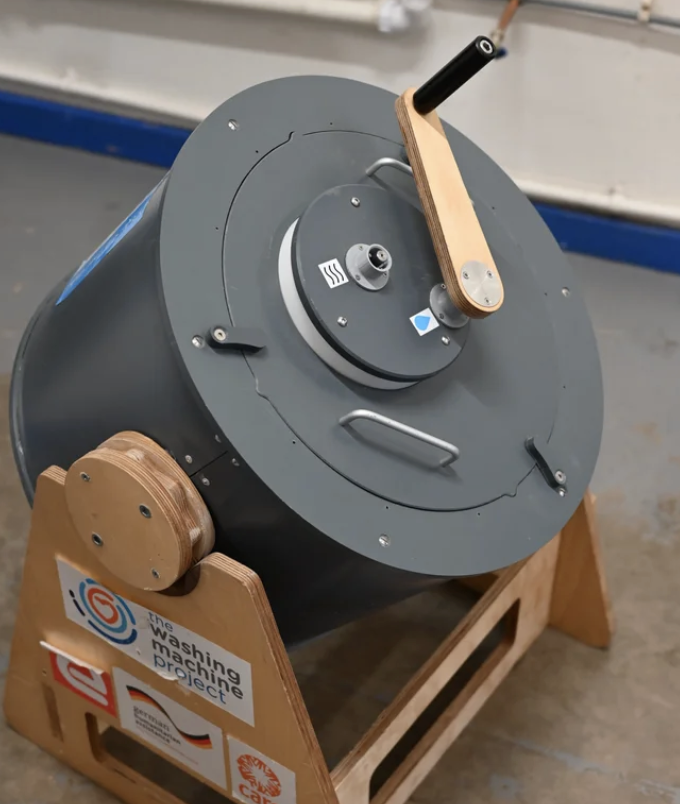
The Washing Machine Project: Globally, up to half the population still washes clothes entirely by hand, spending hours performing grueling manual labor. Whirlpool engineers volunteered their time to help refine and build the Divya Manual Washing Machine—an off-grid, hand-cranked washing machine that requires no electricity. In 2025, Whirlpool employees built 795 machines and distributed them to low-income and displaced communities, including a new distribution network in Mexico, reducing laundry time by up to 75% and water use by 50% for impacted families.
Care Counts: Operating in partnership with Teach for America, this program places washers and dryers in schools across all 50 states. Thousands of children skip school out of shame when they do not have access to clean clothing. By providing laundry access at school, the program has driven a 70%+ increase in attendance rates among participating high-risk elementary students.
5. Where Whirlpool is Winning vs. Where They Are Failing
While Whirlpool’s 2025 report contains many positive metrics, an authentic, balanced look requires reading between the lines. Corporate sustainability reports are carefully designed to highlight victories, but the real truths often hide in what the report reveals about their unresolved struggles.
Let's look at the data with an analytical lens to see where Whirlpool is genuinely succeeding and where their current strategies fall short.
Where They Are Winning
A 55% reduction in market-based Scope 1 and 2 emissions over four years is a stellar achievement. They have effectively decoupled their manufacturing volume from their immediate operational carbon footprint.
Programs like Care Counts and The Washing Machine Project are brilliant because they leverage Whirlpool’s direct engineering expertise. They aren't just writing random charity checks; they are using appliances to directly solve systemic societal issues like chronic school absenteeism and off-grid poverty.
Forcing 69% of their component supply spend through an intensive EcoVadis sustainability screen shows real teeth. They are actively cleaning up the extended corporate network, rather than just claiming clean practices at their own final assembly plants.
Where They Are Failing and Falling Short
Look closely at the report’s Scope 3, Category 11 emissions chart (emissions from products being used in homes). In 2021, this number was 49.4 million metric tons. It dropped significantly to 42.1 million in 2024, but in 2025, it only dropped to 41.9 million. That is a reduction of just 0.2 million metric tons in a year—a virtual standstill. Because product use makes up the overwhelming majority of Whirlpool's total climate impact, this plateau shows that incremental efficiency tweaks on appliances are hitting a wall. True progress will stall until the world's municipal electrical grids dramatically transition away from fossil fuels.
The report proudly notes that they handled 765,102 returned products in their circularity centers. However, only 369,080 of those units were successfully refurbished. That means 52% of all returned products—nearly 400,000 appliances—could not be repaired or resold. Whether they were stripped for spare parts or crushed for scrap metal, failing to refurbish more than half of returned corporate inventory reveals a massive gap in structural repairability and circular design.
Whirlpool states that they match 100% of their U.S. factory electricity with renewable energy. But look at the fine print: they do this primarily by purchasing virtual Renewable Energy Credits (RECs) from two massive wind farms located far away in Texas. Meanwhile, the actual on-site renewable capacity built directly on top of their physical manufacturing plants remains stubbornly low. Their factory in Ottawa, Ohio only gets 30% of its power from on-site systems; Findlay is at a tiny 13%; Marion is at 19%; and the massive plant in Clyde, Ohio is still listed as "Project in planning". Buying financial carbon offsets from Texas wind farms allows for clean corporate bookkeeping, but it doesn't physically clean up the local fossil-fuel-heavy grids in Ohio where their factories are drawing real-time electricity.
While Whirlpool is aggressively pushing toward a 65% reduction in operational emissions by 2030, their supply chain partners are dragging their feet. Of the suppliers who responded to the corporate audit, only 79% have set any emissions reduction targets at all. Shockingly, the collective targets of those suppliers only represent a 23% greenhouse gas reduction by 2030 from a 2024 base year. This reveals a major ambition gap between Whirlpool and its supply network, creating an upstream carbon anchor that will slow down long-term net-zero goals.