How Is Amazon Doing On Their Sustainability Goals? (2025 Report)
When you click "Buy Now" on Amazon, a massive global machine springs to life. With over 1.5 million employees worldwide, thousands of delivery vans on the road, and an expansive cloud computing network powered by Amazon Web Services (AWS), Amazon’s footprint on our planet is undeniable.
Because of its sheer size, when Amazon makes a environmental move, the rest of the corporate world watches. Amazon recently released its 2025 Sustainability Report, detailing its progress toward The Climate Pledge—a bold commitment co-founded by the company to reach net-zero carbon emissions across global operations by 2040.
Amazon’s Chief Sustainability Officer, Kara Hurst, described their ongoing methodology as being "stubborn on our vision and flexible on the details."
But the path to sustainability isn't a straight line. As artificial intelligence (AI) skyrockets, Amazon finds itself in a difficult paradox: using high-tech tools to optimize efficiency while grappling with the massive amounts of energy and water those very technologies require.
Amazon By the Numbers
Before diving into the specifics, let's look at the foundational metrics that defined Amazon’s environmental impact this past year:
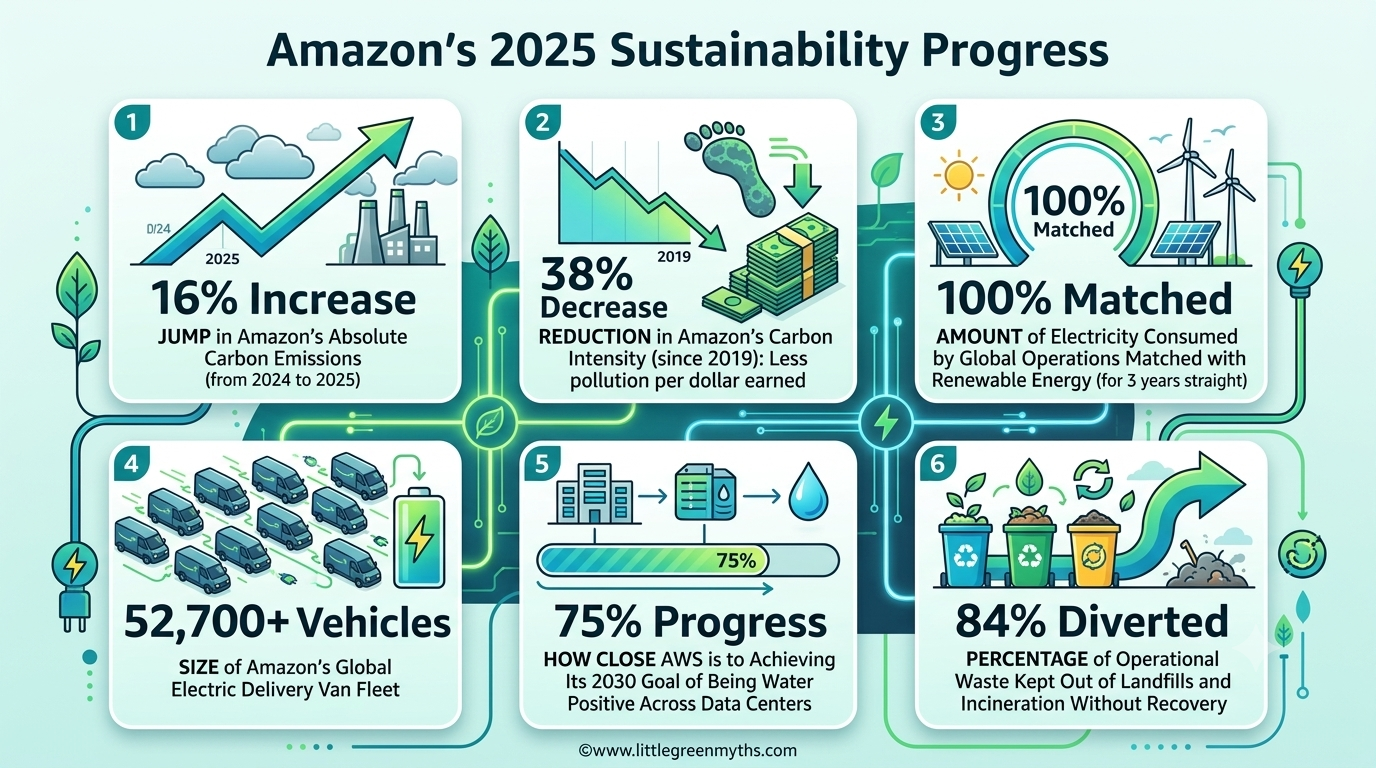
16% Increase: The jump in Amazon’s absolute carbon emissions from 2024 to 2025.
38% Decrease: The reduction in Amazon’s carbon intensity since 2019, showing they are generating less pollution per dollar earned over the long term.
100% Matched: The amount of electricity consumed by global operations matched with renewable energy sources for the third year in a row.
52,700+ Vehicles: The size of Amazon's global electric delivery van fleet.
75% Progress: How close AWS is to achieving its 2030 goal of being water positive across data centers.
84% Diverted: The percentage of operational waste kept out of landfills and incineration without recovery.
Where Amazon is Failing
While Amazon’s report highlights incredible feats of engineering, it does not hide a stark reality: absolute carbon emissions went up by 16% between 2024 and 2025. This is a major setback for a company aiming for net-zero emissions by 2040.
1. The AI Energy Surge and Scope 3 Emissions
The primary culprit behind rising emissions is the explosive growth of cloud services and generative AI. Running advanced AI models requires massive, power-hungry data centers.
Amazon's supply chain emissions (known as Scope 3 emissions), which include things like data center construction, manufacturing devices, and third-party transportation, account for a staggering 76% of their total carbon footprint. These emissions grew by 20% in just one year.
2. Missing Deforestation Commitments

Amazon set clear targets to eliminate deforestation risks from its agricultural supply chains, specifically regarding commodities like palm oil, paper, beef, soy, cocoa, coffee, and tea. While they achieved 33 out of 35 of these goals, they fell short in critical areas:
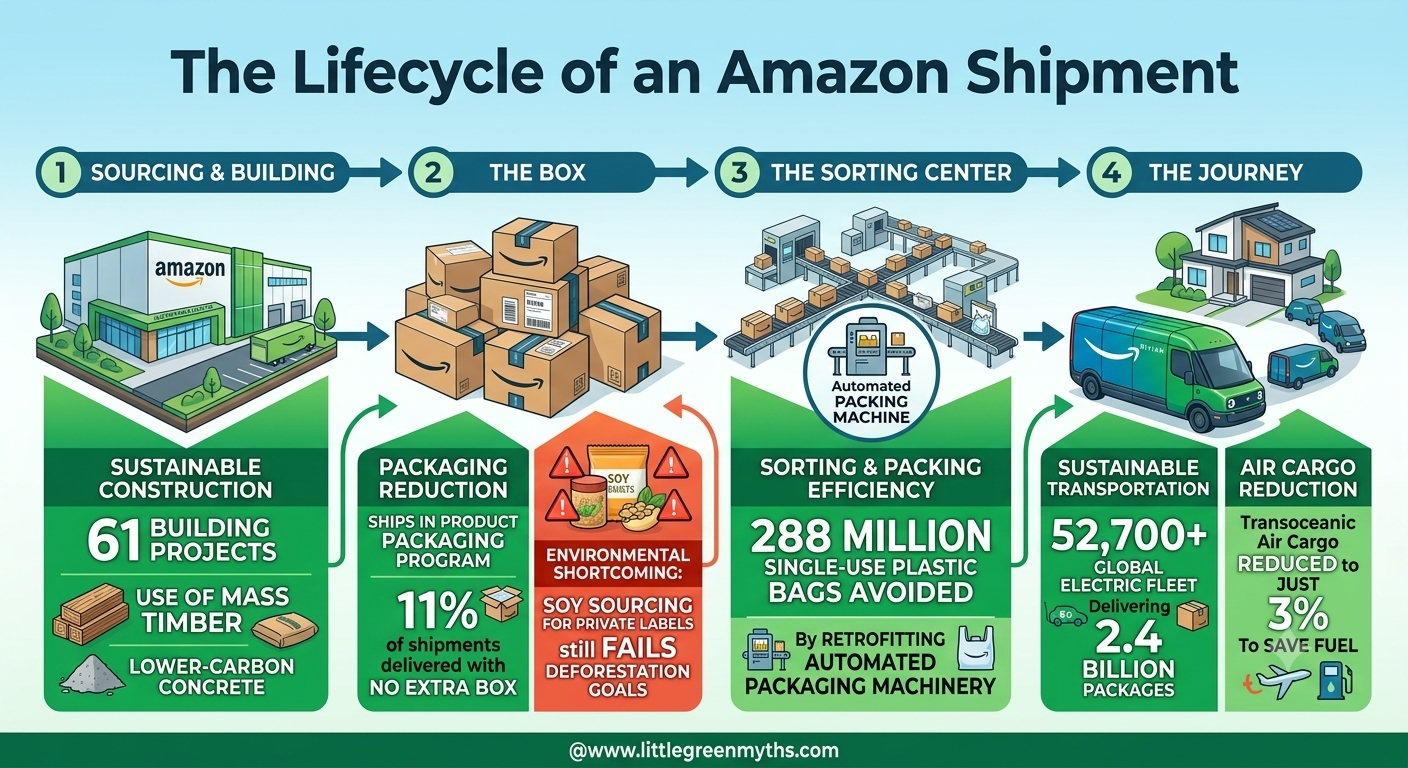
Amazon completely missed its goal to source 100% deforestation-free soy. In Europe, only 10% of the soy used by Amazon Private Brands was verified as Deforestation- and Conversion-Free (DCF). The remaining 90% relied on less reliable "mass balance" tracking and regional credits.
Amazon Grocery Private Brands failed to reach 100% compliance for palm oil from low deforestation risk regions or full traceability, achieving only 94% compliance in North America.
3. Supply Chain Discrepancies
While plastic delivery packaging has been successfully eliminated in Europe, absolute single-use plastic packaging weights actually increased by 34% in Europe (from 894 to 1,199 metric tons) and rose slightly in the "Rest of World" category. This signals that while delivery mailers might be changing, secondary plastics within distribution networks remain incredibly stubborn to root out.
Where Amazon is Succeeding
Despite the setback in total emissions, Amazon is executing some of the most aggressive and well-funded sustainability initiatives in corporate history.
1. The Clean Energy Juggernaut
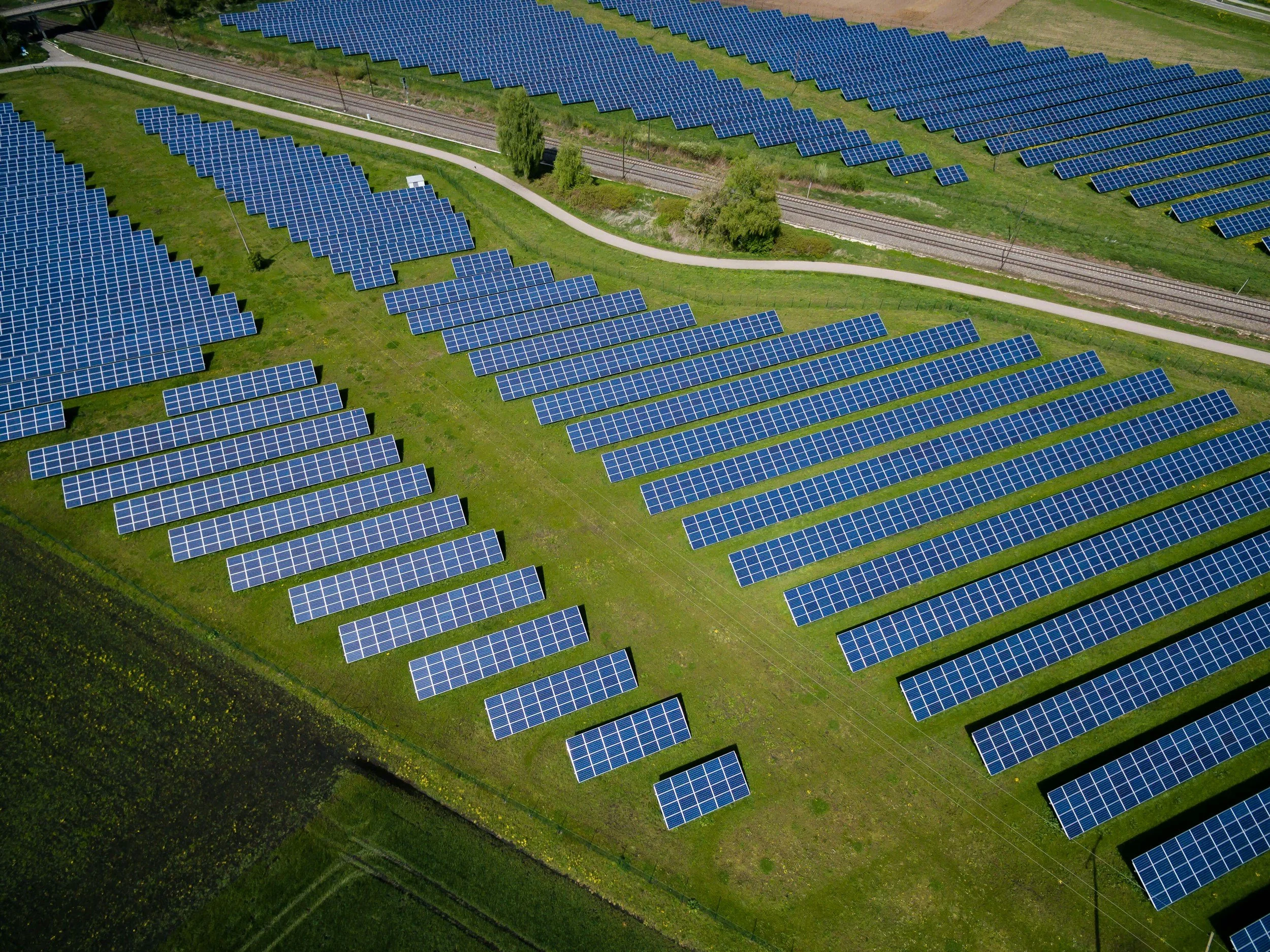
Amazon has maintained its status as the world’s largest corporate purchaser of renewable energy. By investing billions, Amazon matched 100% of its operational electricity use with renewable energy in 2025. Their portfolio now includes over 712 clean energy projects across 30 countries, encompassing wind, solar, and rooftop arrays.
To solve the issue of solar and wind power being intermittent (since the sun doesn't shine at night), Amazon is going all-in on Next-Gen Nuclear Power. They invested in small modular reactors (SMRs) through a developer called X-energy to bring 5 gigawatts of nuclear energy to the U.S. grid by 2039. They also secured a long-term agreement with Talen Energy for 1,900 megawatts of carbon-free nuclear power through 2042.
2. Transportation Revolution
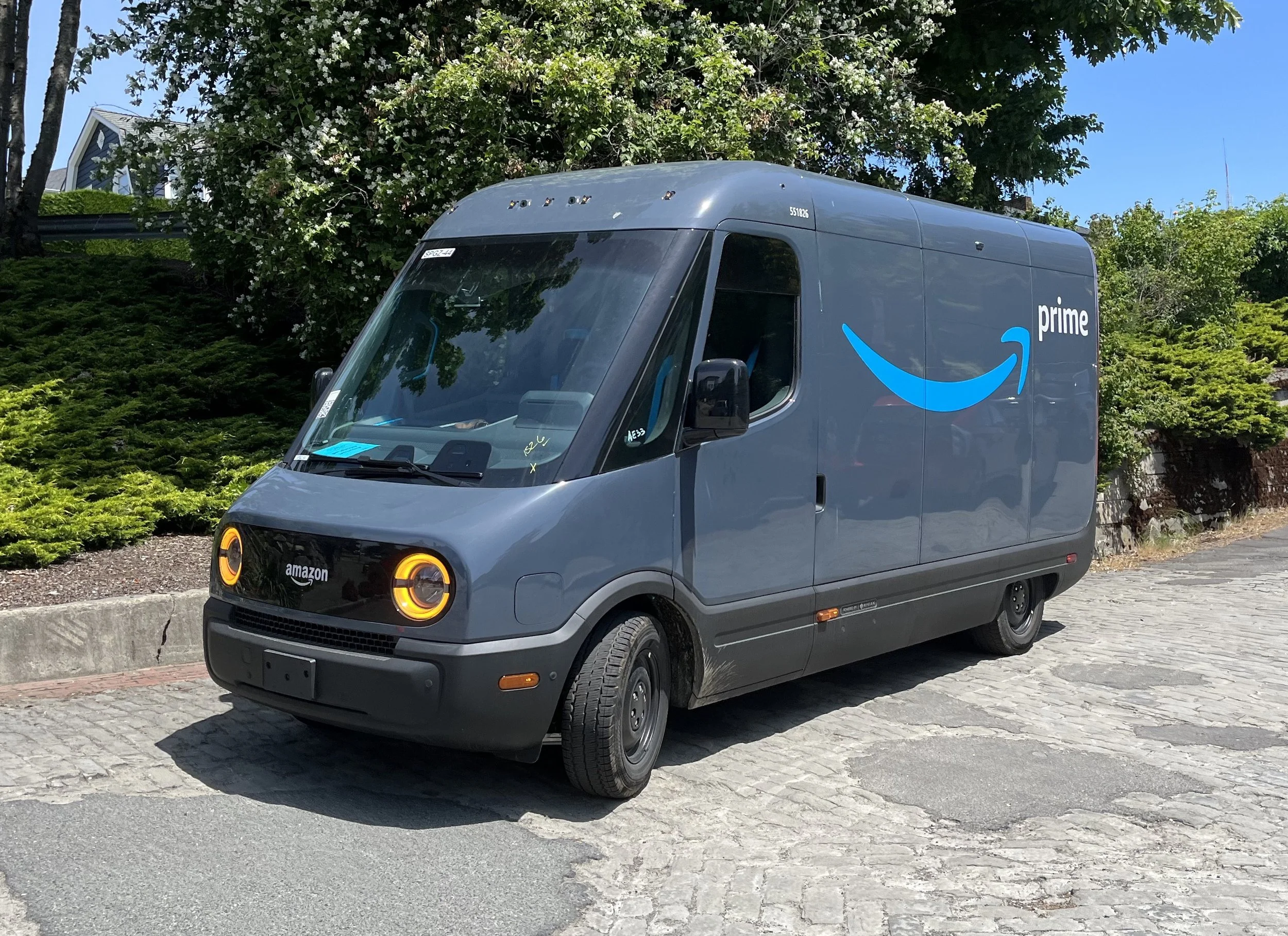
If you live in North America or Europe, there is a high probability your package arrived in an electric vehicle.
Electric Delivery Vans (EDVs): Amazon has deployed more than 52,700 electric delivery vans globally, which delivered 2.4 billion packages in 2025 alone.
Micromobility: In tight urban centers across Europe and Asia, Amazon utilizes 75 micromobility hubs to deploy e-cargo bikes and walking deliveries, entirely removing tailpipe emissions from local neighborhoods.
3. The Water Positive Breakthrough in India
Data centers require cooling, which usually consumes massive amounts of water. Amazon committed to becoming "water positive"—meaning they return more water to local communities than they consume in direct operations.
In India, one of the most water-stressed regions in the world, Amazon achieved 120% water positivity in 2025, hitting their goal two years ahead of schedule. They did this by recycling wastewater through on-site sewage plants across 28 buildings and installing massive rainwater harvesting systems.
4. Ditching the Plastic Mailer
In North America, Amazon engineers successfully retrofitted automated packaging machines to swap out plastic for custom-sized, recyclable paper bags, avoiding 288 million single-use plastic bags in 2025. Today, 73% of shipments in North America are fully recyclable in residential household waste streams.
We have also seen a move towards Low Carbon shipping. Typically, ordering online instead of driving to multiple stores generates fewer carbon emissions, and Amazon has reduced emissions per shipped unit by 7% compared to 2024 and 39% compared to 2019.
5. Reuse
Amazon offers customers repair of defective products through qualified partners when possible. In 2025, top repair categories included personal electronics and kitchen items.
Customers can trade in qualified used Amazon devices and other electronics in exchange for Amazon credit. Traded-in devices are either refurbished and resold or responsibly recycled through certified partners. In 2025, customers traded in 835,000 devices.
AI: A Double-Edged Sword for Sustainability
The report highlights a fascinating reality: AI is causing the energy crisis, but it is also providing the tools to solve it. Amazon actively leverages AI models across its entire value chain to minimize waste:
Infrastructure Monitoring: AI monitoring tools track HVAC, refrigeration, and electrical systems across 820 buildings to instantly spot energy anomalies and fluid leaks.
Advanced Recycling: Amazon partnered with robotics startups to use Al-powered robots that unscrew, demanufacture, and sort decommissioned server parts from data centers so rare materials can be safely recycled.
Perfecting Packaging: AI algorithms analyze a product's size, shape, and durability against customer feedback to calculate the absolute thinnest, lightest box or paper mailer required to ship it safely.