Behind the Brew - Keurig’s 2025 Sustainability Report
To be honest I can’t say I am a fan of Keurig, as I would rather not waste so much plastic to make my coffee because we already have microplastics everywhere. And I prefer to choose from one of my favorite filterless coffee makers.
But, if you’ve ever grabbed a Snapple from the fridge, popped a K-Cup pod into a brewer, or cracked open a cold Dr Pepper, you are interacting with Keurig Dr Pepper (KDP). Yes, you saw that right, Dr. Pepper. My favorite drink to have with my Taco Bell mexican pizza I need to have when I am depressed, shhhh. They are one of the biggest beverage giants in North America, boasting around 30,000 employees and bringing in a massive $16.6 billion in net sales in 2025 alone.
But with billions of drinks flying off the shelves comes a massive responsibility. What happens to the plastic bottles? How much water does it take to make that juice? Are the farmers who grow the coffee beans being treated fairly?
To answer these questions, KDP releases an annual "Impact Report". Their guiding motto is "Drink Well. Do Good." But corporate mottos are easy to write; real-world change is much harder. Now that we are in 2026, the company has released its look back at the 2025 calendar year.
1. Climate & Nature Action: The Air We Breathe & The Land We Farm
When we talk about a company's carbon footprint, we look at greenhouse gas (GHG) emissions. These are the gases that trap heat in our atmosphere and drive climate change. KDP has set serious, science-validated targets to lower these emissions. However, their 2025 data shows that saving the planet is a bumpy ride.
KDP’s climate strategy rests on four pillars: energy efficiency in their factories, switching their massive delivery fleets to low-carbon options, supporting eco-friendly "regenerative agriculture" on farms, and fighting deforestation. Because more than 97% of their total emissions come from their "Scope 3" value chain—which includes everything from growing ingredients to consumers running their coffee makers at home—they have to work closely with outside partners to see real progress.
Where They Are Succeeding
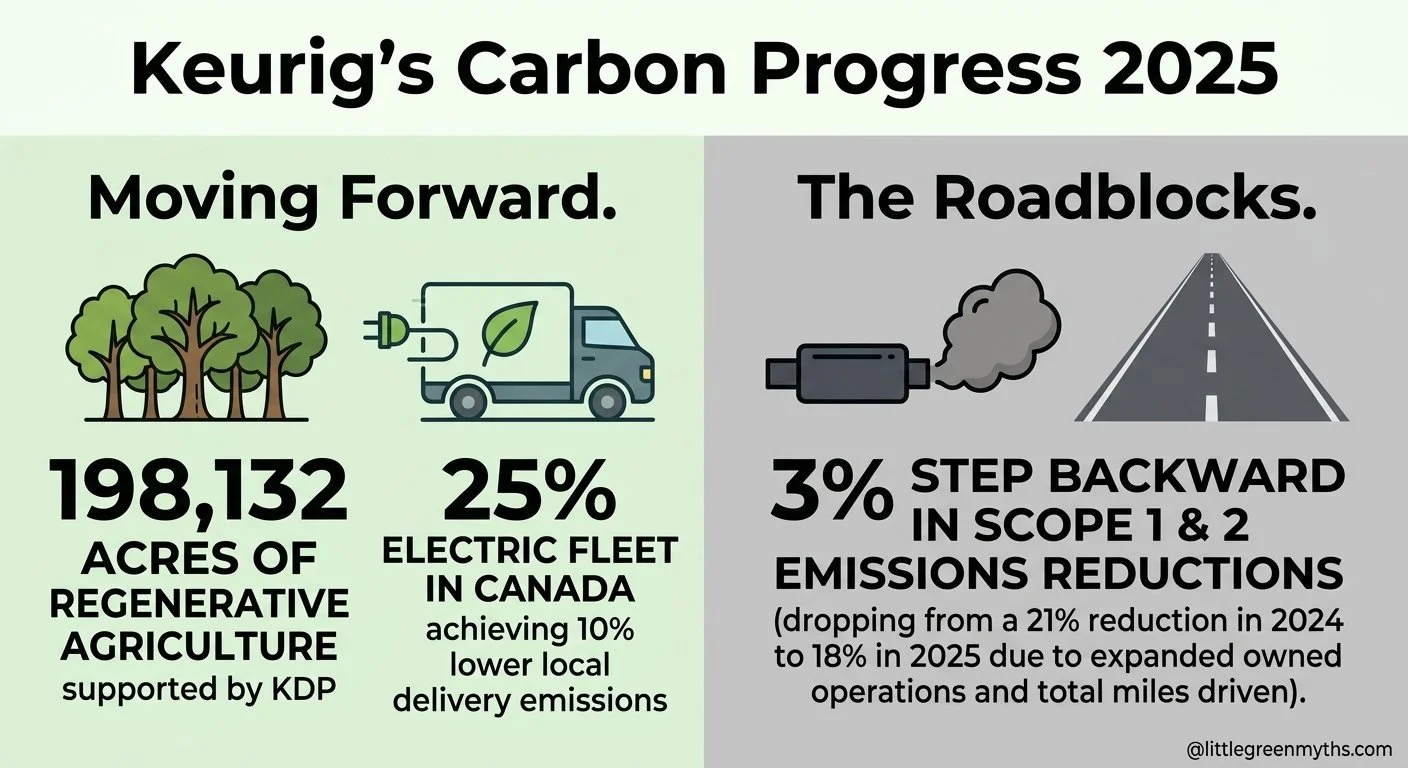
Regenerative Agriculture: Since 2022, KDP has supported eco-friendly farming practices on 198,132 acres of land. These practices keep the soil healthy, protect bugs and wildlife, and help the ground absorb carbon instead of releasing it.
The Canadian Fleet: Up north, KDP Canada has expanded its electric vehicle fleet to 67 trucks. This means more than a quarter of their entire Canadian fleet is now electric, which helped cut local delivery emissions by 10% over the year.
Aerodynamic Trailers: In late 2025 and early 2026, KDP retrofitted 1,200 delivery trailers in the U.S. with aerodynamic devices. These simple wind-guards save an estimated 1.1 million gallons of diesel fuel and cut 3,000 metric tons of carbon emissions annually.
The "Blue Harvest" Success: Working with Catholic Relief Services in Honduras and Nicaragua, KDP helped over 4,000 coffee farmers adopt methods that protect local water and restore soil. The bonus? Farmers saw their coffee yields increase by an average of 8.6%.
Where They Are Failing & Challenged
The Emission Reversal: Here is the candid truth: KDP's direct operations (Scope 1 and 2) emissions actually increased between 2024 and 2025. While they have achieved an 18% reduction compared to their old 2018 baseline, they actually slipped backward from the 21% reduction they celebrated in 2024. Why? Because the company grew, bought more facilities, and their delivery trucks drove millions of extra miles across the U.S. and Mexico.
The U.S. Fleet Roadblock: While Canada's electric fleet is thriving, KDP admits that scaling up electric delivery trucks in the U.S. is currently stalling due to a lack of heavy-duty truck technology, supportive government policies, and charging infrastructure.
2. Water Stewardship: Every Drop Counts
Water is the lifeblood of the beverage industry. It’s the primary ingredient in almost everything KDP sells, and it’s used heavily in their manufacturing plants to keep things clean and running. KDP has a goal to reach a "Positive Water Impact" by 2050, meaning they want to put more water back into nature than they take out. But 2025 proved that keeping this promise is incredibly tough when production lines are expanding.
KDP targets what they call "high water-risk locations"—places prone to severe droughts and water scarcity. They try to do two things: make their factories hyper-efficient so they waste less water, and fund "water replenishment" projects in nearby communities to restore local rivers and wetlands.
Where They Are Succeeding
Community Replenishment: KDP has invested in 17 targeted water replenishment projects across Texas, California, Florida, and Mexico since 2016. In 2025, these projects successfully delivered 3,283 megaliters (about 866 million gallons) of water back into nature—a 9% jump from 2024.
The Texas Wetlands Project: In 2025, a project KDP supported in the Trinity River Basin of Texas had its first full year of operation. By building water-control infrastructure across 111 acres of wetlands, they managed to capture, clean, and return 345 million liters of water to the river system.
Target Achievement: In 3 of their 11 highest-risk operating sites, KDP successfully hit 100% of their water replenishment goals.
Where They Are Failing & Challenged
Efficiency is Slipping: To measure factory efficiency, KDP uses a "Water Use Ratio"—the liters of water required to make one liter of actual drink. Lower numbers are better. KDP wants to hit an average ratio of 1.8 across all facilities by 2030. Instead, their ratio got worse, climbing from 1.91 in 2024 to 2.03 in 2025. In high-risk areas, it also jumped from 1.74 to 1.87. This means they are using more water to mix and make their drinks than they did a year ago.
Diluted Target Performance: Because KDP expanded its production and added new factory sites to its high-risk list, its overall water replenishment progress metric actually dropped from 70% down to 62% in 2025. They are restoring more total volume, but they are consuming far more than they can keep up with.
3. Packaging & The Plastic Problem: Driving a Circular Economy
Walk down any trash or recycling aisle, and you’ll spot the ultimate villain of modern environmentalism: single-use plastic. For KDP, packaging is a massive piece of the puzzle. They want to create a "circular economy" where materials are recycled and reused endlessly rather than thrown into a landfill.
KDP's game plan relies on three things: designing packaging that is genuinely recyclable or compostable, substituting raw "virgin" plastic with post-consumer recycled (PCR) materials, and investing millions of dollars into upgrading municipal recycling systems across North America.
Where They Are Succeeding
Smart Design: An impressive 96% of KDP’s entire packaging portfolio is now designed to be recyclable or compostable according to industry standards.
Virgin Plastic Cuts: Compared to 2019, KDP has reduced its use of brand-new, oil-based virgin plastic by 21%. They did this by lightweighting their bottles and changing up their product mix.
Pod Acceptance in Canada: KDP worked closely with Canadian recycling regulators, successfully convincing province-run recycling programs in Ontario and Quebec to officially accept K-Cup pods. This now covers over 36% of the Canadian population.
The "Alta" Project: KDP is beta-testing a new brewing system called Keurig Alta. Instead of plastic pods, it uses "AltaRounds"—pressed coffee pucks wrapped in a plant-based coating that are certified home-compostable. The system is scheduled for a limited online launch in late 2026.
Factory Waste Diversion: KDP’s factories are excellent at sorting their own waste, keeping 92% of manufacturing trash out of landfills. Their dedicated coffee plants did even better, hitting a 97% diversion rate.
Where They Are Failing & Challenged
Recycled Plastic Stagnation: KDP wants 25% to 35% of its primary plastic bottles and containers to be made of recycled plastic (PCR) by 2035. But in 2025, they hit a flat wall at just 16% PCR content—the exact same percentage they recorded in 2024. The reason? Consumers simply didn't buy as many of the product formats that use 100% recycled plastic bottles.
The Confusion Patchwork: Even if a bottle is designed to be recycled, KDP notes that the U.S. recycling system is a broken patchwork of 9,000 separate local programs. Because every town has its own rules, studies show that roughly 60% of people remain completely confused about what actually goes into the blue bin.
4. Supply Chains & Human Rights: Sourcing Responsibly
A beverage company is only as good as the raw crops it buys. Coffee beans, cocoa, apples, corn, and citrus are grown by thousands of farmers worldwide, often in developing countries vulnerable to climate change and unfair labor conditions.
Where They Are Succeeding
Worker Resilience: Since 2024, KDP has funded economic stability programs that directly supported 10,061 coffee farmers and farmworkers to help boost their incomes and adjust to climate change.
An Invisible Safety Net: In 2025, KDP joined the Nossa Voz ("Our Voice") initiative in Brazil. It’s a tech-enabled anonymous hotline where local coffee farm workers can securely report human rights abuses or unsafe working conditions to local operators who build customized remediation plans.
Factory Compliance: Through their Supplier Rating System, KDP audited 121 key ingredient and component factories. 94% met or exceeded corporate ethical standards.
Where They Are Failing & Challenged
The Coffee Sourcing Dip: For years, KDP proudly sourced 100% of its coffee responsibly. In 2025, that number dropped to 97%. What went wrong? Political tariffs. The U.S. government implemented rapid tariffs on coffee imports. To protect their production timelines before prices skyrocketed, KDP had to bypass their regular certified suppliers and buy unverified "conventional" green coffee directly from the open spot market.
The Sourcing Blindspot: KDP openly admits that for their 100% responsibly sourced cocoa, they rely on a "mass balance" accounting system. This means certified sustainable cocoa is mixed with conventional cocoa during processing, meaning KDP cannot fully trace every single bean back to a guaranteed deforestation-free farm.
5. Health, Safety, & Well-Being: People and Products
Sustainability isn't just about trees and water; it's about people. This includes the health of the consumers drinking these beverages and the safety of the frontline employees working the factory floors.
Consumer Health Wins
KDP has successfully cut added sugar across its U.S. refreshment beverage portfolio by 10% since 2020. If you look strictly at their juice drinks, they have cut added sugar by a whopping 28%. Furthermore, 61% of their entire U.S. beverage lineup now officially meets their internal "Positive Hydration" guidelines (meaning the drink is either low-calorie, provides essential vitamins, or contains a serving of fruit/veggies without added sugar). They also maintained a strict marketing boundary: zero advertising directed at kids under 13 years old.
Workplace Culture and Safety Roadblocks
On the employee side, things are generally positive: 82% of surveyed workers reported feeling highly engaged at work, and the company launched an AI platform called "Career Hub" to help staff map out internal promotions and build skills.
However, the safety sector ran into hitches. KDP characterized 2025 as a "year of transition" for workplace safety. In corporate speak, that means they struggled. As they rapidly acquired brand-new manufacturing facilities, they faced roadblocks trying to establish their safety protocols with new factory leadership while simultaneously managing high employee turnover in frontline roles.