The Solo Living Trend Is Wreaking Havoc On Our Energy Use

Have you ever dreamed of having your very own apartment? No roommates leaving dirty dishes in the sink, no siblings barging into your room, and complete control over the TV remote. I have this dream every day as I stare at the dishes, clothes strewn on the floor, and chores left behind by my college roommates, eh I mean my teenagers.
For many people, living alone sounds like the ultimate dream. But have you ever stopped to think about what happens when millions of people all make that same choice?
The rise of solo living is changing the world in ways we might not even realize. It is creating significant social and environmental challenges, especially in high-income countries like Denmark. In fact, right now in Denmark, nearly half of all households—46% to be exact—consist of just a single occupant. Women make up 26% of these solo households, while men account for 20%. This massive shift places Denmark among the global leaders in the trend of living alone.
A fascinating recent study in Nature, based on in-depth interviews with 23 people living alone in Denmark breaks down the reasons behind this trend and the impact it has on our world.
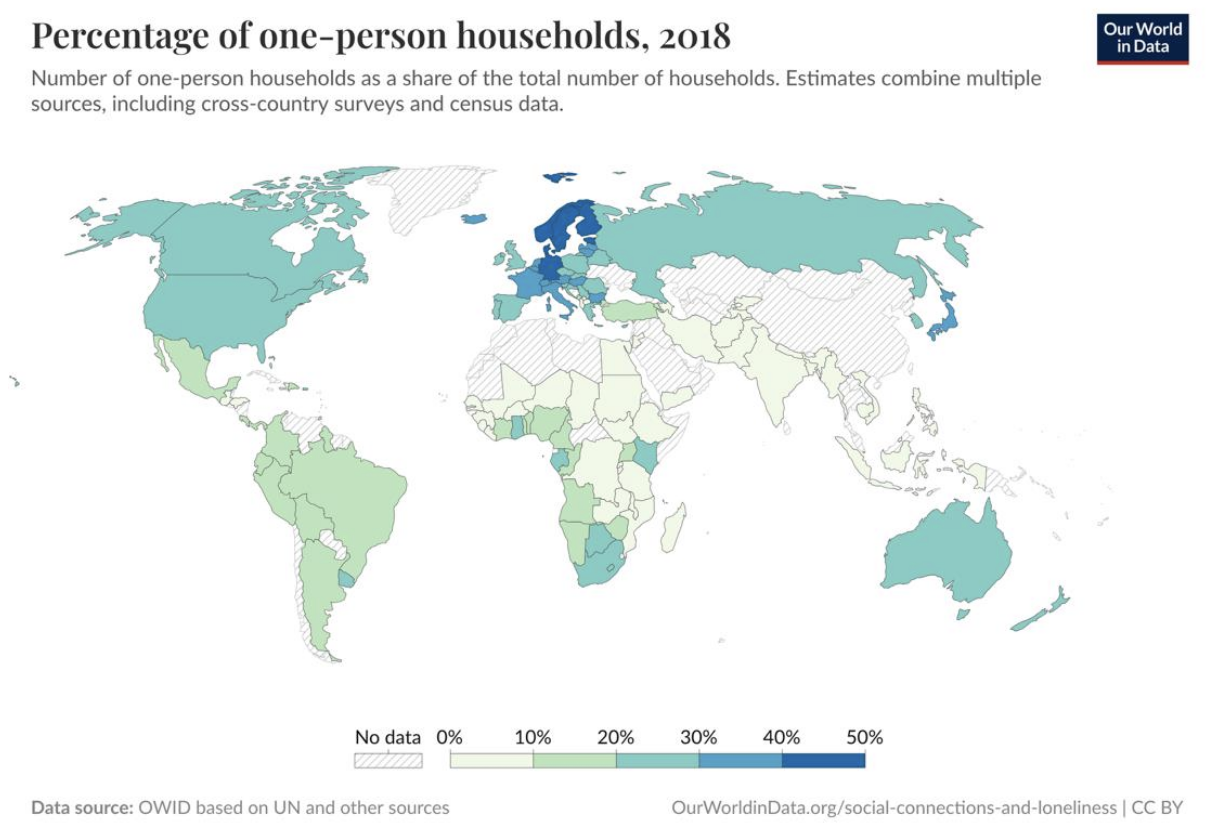
Why Is Everyone Living Alone?
The trend of people living by themselves isn't just a random coincidence. It is driven by several major shifts in how our society works. Here are the main reasons why solo living is on the rise:
Aging Populations: People are living longer. As populations age, many older adults simply prefer to continue living independently in their own homes rather than moving in with family members or relocating to institutional care settings.
Changing Relationships: People are waiting longer to get married. At the same time, rising divorce rates and a growing preference for "living apart together" (where couples stay together but maintain separate homes) are leading to more solo households.
Financial Independence: Higher income levels have made living alone a realistic option for more people. This is particularly true for women, whose increasing financial independence has facilitated the rise in solo living.
The Four Paths to Living Alone
You might think that everyone who lives alone does so because they desperately want to. Surprisingly, the study found that many people end up living alone unintentionally and are actually very open to shared living in the future.
The Urban Transplants
These are people who relocated to a new city for work or education. Moving to a new place means navigating a complex new life, and these individuals often lack the local networks needed to find shared housing. Even if they have enjoyed living with roommates in the past, they frequently end up in single-occupancy apartments because they simply can't find a good shared opportunity. For example, one 27-year-old participant named Lina tried to find a shared house when she moved for work, but she couldn't find anything suitable and views living alone as just a temporary phase.
The Age Outers
These individuals used to love shared living arrangements, such as living in a collective or a busy student house. However, as they got older and progressed through different life stages, the dynamics of shared housing started to feel increasingly burdensome. They eventually felt that they should stop sharing and get their own place. Participants mentioned feeling fed up with strangers having a say in how they run their house or getting tired of the daily negotiations and compromises that come with roommates.
The Empty Nesters
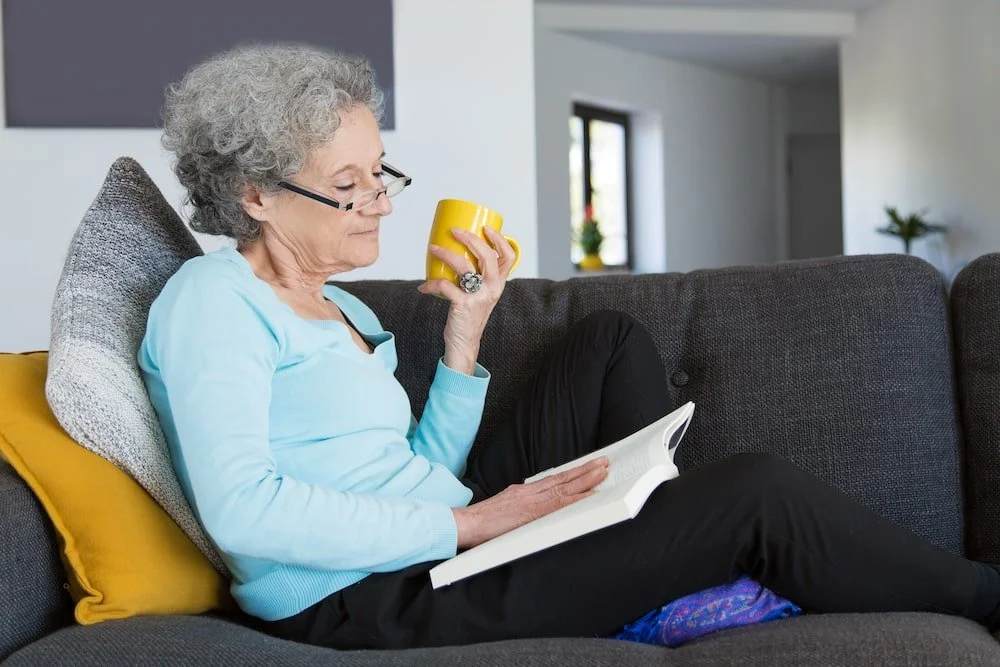
This group is exactly what it sounds like. These are older adults who are living alone because their children have grown up and moved out. They tend to live alone intentionally but haven't really considered shared living options, often staying in the same homes they raised their families in.
The Solitude Seekers
Unlike the other groups, Solitude Seekers actively and intentionally decided to live alone. Some get easily distracted by other people's energies and simply need their own space. Others choose to live alone even while in long-term romantic relationships because they value their time and independence. Additionally, some participants noted that living alone helps them manage mental health diagnoses by giving them control over their environment and reducing social stimulation and conflict.
The Gender Divide: Empowerment vs. Stigma
One of the most fascinating takeaways from the study is how differently men and women experience living alone.
For women, living alone is often viewed as emancipatory. Women in the study, both young and old, expressed a strong sense of pride and empowerment in living independently. Older female respondents who had previously lived with male partners were particularly eager to live alone. In heterosexual relationships, women typically take on the bulk of domestic and emotional labor. Even in Denmark—a country that is second only to Sweden in the EU for narrowing the gender gap in unpaid household work—women still spend nearly an hour more per day on household labor than men do. Because of these complex experiences with caregiving and an unequal division of labor, many women expressed reluctance to ever cohabitate with a partner again. Living alone frees up their time and energy to focus on their own pursuits.
For men, the experience can be quite different.The study noted that men express more stigma around living alone. Men generally see living alone as a temporary life stage, and many of them fully expect to eventually move in with a female partner. In fact, nine of the eleven men interviewed had rented or bought larger apartments specifically in anticipation of a potential partner moving in. One 57-year-old participant even mentioned buying a 120-square-meter apartment thirty years ago to use as an "imagined bargaining chip" to attract a partner, telling them they could redecorate the whole place if they moved in. The study highlights that societal expectations on men regarding independence and being a provider might contribute to feelings of lost potential or inadequacy when they end up living alone long-term.

The Environmental Cost of Flying Solo
While having your own space can be great for personal freedom, it poses a massive challenge for planetary sustainability.
Solo living leads to significantly higher per capita resource use and consumption. Think about it: every household, whether it has one person or five people, usually requires its own set of appliances, electronics, and consumer products. A single person living alone still needs a refrigerator, a washing machine, an oven, and internet routers.
Because small households cannot share these resources, they have much higher patterns of energy consumption and waste generation compared to larger households. The statistics are eye-opening: single householders have double the average per capita carbon footprint compared to people who live in households of more than five. The participants in this study had estimated carbon footprints ranging from 4.8 to 27.0 tonnes of CO2 per year, with an average of 13.0 tonnes. This average is a full 4 tonnes higher than the standard Danish average of 9 tonnes of CO2 per year.
Furthermore, widespread under-occupancy is contributing to global housing crises. During in-home interviews, the researcher noticed that participants living alone often had a spare room or extra unused space. This unused space requires construction materials to build, ongoing maintenance, and energy for heating, yet it remains completely unoccupied. Not only is this a financial burden, but it also directly contributes to higher energy consumption.
The Power of Sharing
The good news is that understanding why people live alone gives us the tools to create better solutions. Because many solo dwellers actually live alone unintentionally and are open to shared living, there is a massive opportunity to change how we build our cities and communities.
Shared living spaces have incredible potential. By promoting shared living, we could significantly reduce individual carbon footprints. Sharing resources means fewer duplicated appliances, less wasted heating in empty spare rooms, and a massive reduction in overall resource consumption.
Furthermore, many people who live alone experience loneliness and lower social capital. Encouraging co-living arrangements—like modern collectives, senior cohousing, or better-designed shared apartments—can help combat urban loneliness while simultaneously tackling the housing crisis. Policy interventions that promote shared living represent a highly promising approach to reducing carbon footprints while also enhancing social wellbeing.
Ultimately, the goal isn't to force everyone to live with roommates forever. It's about recognizing that our current housing systems make it difficult for people to share space comfortably. By redesigning our cities and social norms to make shared living more attractive and accessible, we can create communities that are better for our mental health, our wallets, and our planet.