How This Little Beetle Solved the Problem of Friction
Have you ever thought about how insect legs work? Insects are the absolute largest animal group on planet Earth, boasting an estimated six to ten million living species.
While they come in all shapes and sizes, they share a very successful basic ground plan: a hard chitinous exoskeleton, a body divided into three parts (the head, thorax, and abdomen), and three pairs of articulated legs.
Part of their massive evolutionary success comes down to something we rarely think about: the brilliant simplicity and dramatic efficiency of their leg joints.
Whether you are a human running a marathon or a tiny insect scurrying across a leaf, it is absolutely essential for your joints to reduce wear and friction without losing the ability to support weight and movement. However, the way a human body solves this problem is completely different from how an insect solves it.
Researchers at Politecnico di Bari looked at the darkling beetle (Zophobas morio) to discover how its tiny joints are inspiring the future of human engineering.
Fluid vs. Solid Lubrication
When two surfaces rub together, they create friction, which eventually leads to wear and tear.
In vertebrates—like humans, dogs, and birds—evolution solved this problem with fluid. Our articular joints are enclosed in a capsule that contains synovial fluid. This fluid lubricates the soft cartilage tissues covering the ends of our bones, creating a complex "boundary lubrication" regime that keeps our joints hydrated and moving smoothly.
Insects, specifically beetles, use a completely different and somewhat simpler biomechanical solution.
Unlike vertebrate joints, beetle joints are completely open. To prevent the hard, solid parts of their exoskeleton from grinding against each other (which would cause high friction and heavy wear), they do not use fluid. Instead, they use a specialized lubricant that is secreted right through tiny pores located on the contacting joint surfaces.
Scientists specifically studied the femoro-tibial joint (the "knee" between the femur and the tibia) of the darkling beetle to figure out exactly how this works.
The Biological Micro-Bearing
From a purely mechanical perspective, a beetle's joint behaves exactly like a bearing. But instead of the traditional ball bearings or needle bearings you might find in a skateboard wheel or a car engine, the beetle uses biological solid lubrication.
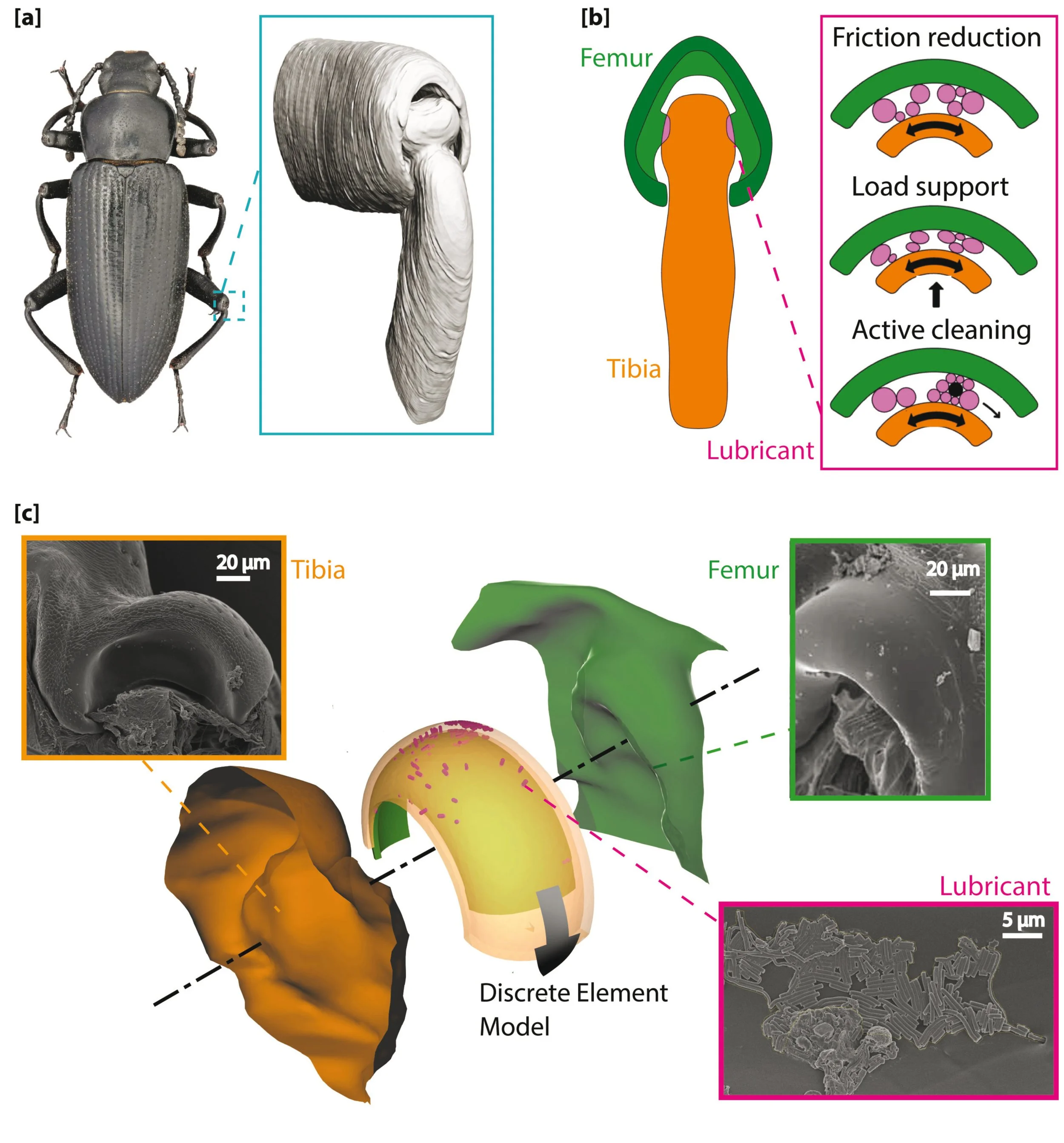
Through scanning electron microscope (SEM) images, researchers discovered that this lubricant is made up of a discrete number of relatively soft, elongated-cylindrical filaments.
These tiny filaments act as rolling elements at a sub-millimetric scale, ensuring low friction and low wear. Essentially, the beetle’s leg joint functions much like a rolling element bearing, but with incredibly unique features designed for challenging environments.
These tiny filaments don't just sit there; they have three very specific jobs to keep the insect moving perfectly:
Friction Reduction: They interpose themselves between the two hard cuticle counterparts (the femur and tibia), acting as rolling elements that allow the joint to glide smoothly.
Load Support: As the insect moves, it experiences different forces. The filaments help accommodate overloads and prevent direct, damaging contact between the hard joint parts.
Active Cleaning: This is perhaps the coolest feature! The filaments are stochastically (randomly) deployed, but they can agglomerate or clump together depending on the joint's conditions, such as local pressure peaks. These large clusters of filaments actually trap contaminant elements, like dust particles. Once trapped, the rolling motion helps drag these contaminants out of the joint entirely. This "active cleaning" is essential for keeping wear levels low.
How Did Scientists Figure This Out?
You might be wondering how on earth someone measures the friction of a microscopic filament from a beetle's knee. It requires a cross-disciplinary approach, combining entomology (the study of insects), material science, and mechanical engineering.
The researchers dried out the beetle legs and coated them with gold-palladium. This allowed them to take highly detailed, microscopic photos of the joints and measure the length of the individual lubricant filaments.
Micro-computed X-Ray tomography (Micro-CT): Similar to a medical CT scan but much smaller, this tool was used to create a precise 3D reconstruction of the dry foreleg of the beetle.
Atomic Force Microscope (AFM): This is where it gets really precise. Scientists used an AFM to perform "nano-indentation" on the filaments. They attached a tiny hydrophobic glass bead (with a radius of just 6 µm) to a microscopic cantilever and poked the lubricant. They indented the filaments by a mere 20 nm to ensure they were testing individual threads. This is how they determined the physical stickiness and stiffness of the material.
Micro-Tribometer: They actually collected the lubricant directly from the pores of the beetle joints and placed it on a clean glass slide. Using a specialized micro-tribometer, they performed normal pressing tests (pushing down) and tangential tests (sliding back and forth) to measure the actual sliding friction coefficient.
Discrete Element Method (DEM): Finally, because testing a single filament isn't enough to understand how thousands of them work together, they fed all this data into a computer. They built a numerical simulation to mimic how entire clusters of these particles roll, squish, and slide between the beetle's femur and tibia.
Through their computer simulation, the scientists made a fascinating discovery about how the amount of lubricant affects the friction in the insect joint.
They found that as the mass of the lubricant increases, the frictional torque initially decreases. Why? Because having more filaments spreads out the pressure. The mean pressure acting on each individual particle drops, and the filaments can form larger, more effective clusters rolling at the interface.
However, there is a limit! The friction eventually plateaus when a certain amount of lubricant mass is reached. If the clusters become too large, they take on irregular shapes. For these oversized clusters to roll into the tight gap between the femur and the tibia, they have to physically conform and squish down, which actually dissipates energy and increases frictional interactions.
Nature, it seems, has found the perfect mathematical balance of just enough lubricant to keep things rolling perfectly without gumming up the works.
Why Does A Beetle’s Knee Matter to Us?
You might be asking, "This is cool biology, but why are material scientists and engineers studying it?"
The answer lies in the future of human technology. As we build smaller and smaller machines—like micro-sensors and micro-actuators—we run into a massive problem called "stiction". Stiction (static friction) causes tiny parts to stick together and fail, and it is a major cause of failure in micro-technologies. You can't just squirt standard oil into a microscopic machine; it doesn't work the same way at that scale.
By comprehensively assessing how the darkling beetle successfully uses a solid lubrication mechanism in a sub-millimetric environment, scientists now have a methodological framework. They understand that by correctly tuning the stiffness, adhesion, and friction properties of lubricating particles, solid lubrication can be highly effective at an extremely small scale.
This provides a "lesson from Nature" for designing artificial, biomimetic solutions. The next generation of low-friction micro-bearings used in medical devices, robotics, or aerospace sensors might just be modeled after the knee of a humble beetle!